
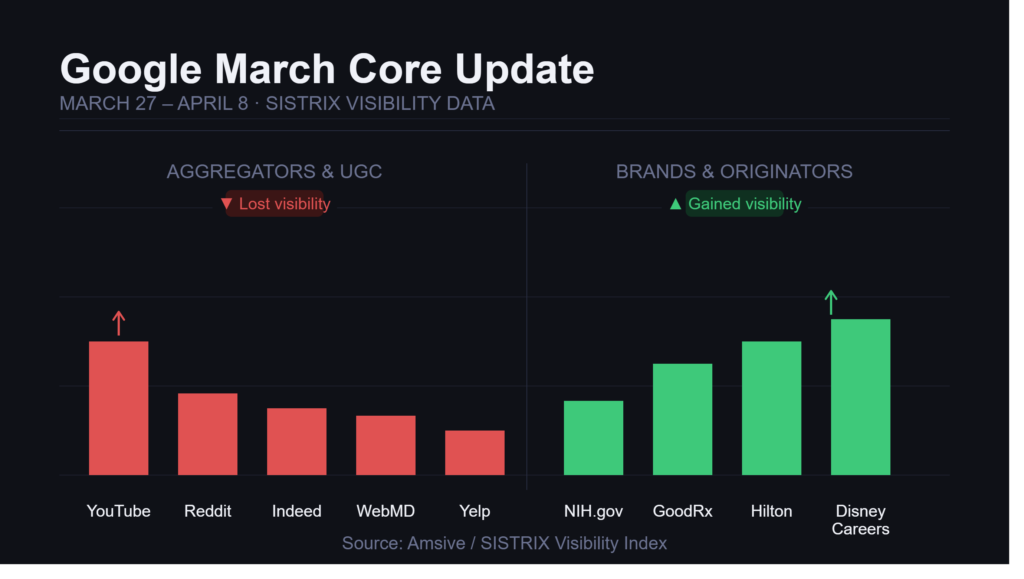
Google's March core update rolled out between March 27 and April 8, 2025. Amsive's post-update analysis of over 2,000 domains using SISTRIX Visibility Index data gives the clearest picture yet of what changed and who paid for it.
The short version: platforms that aggregate or host other people's content took significant visibility hits. Sites that own the content they publish gained ground.
What the data covers
Type youLily Ray of Amsive categorized domains using Google Product Taxonomy tags via the DataForSEO API. The analysis compares SISTRIX visibility scores on March 27 (the day the rollout started) versus April 8 (the day it completed).
SISTRIX measures keyword visibility, not organic traffic directly. That's an important distinction. Visibility changes don't map 1:1 to traffic changes, and other factors can shift visibility scores during an update window. Read the data as a directional signal, not a precise traffic report.r paragraph here
YouTube led all losers
YouTube dropped 567 visibility points, the largest single-domain decline in Amsive's dataset. That's roughly 30% larger than Wikipedia's 435-point drop during the December core update.
Ray notes the drop brought YouTube's visibility back to its level before an early March surge, rather than pushing it to a new low. That context matters: the update may have corrected a temporary gain rather than penalized the domain fundamentally.
Other major UGC platforms followed: Reddit lost 64 points, Instagram 48, and X 46.
Category patterns: travel, jobs, and health
Type your paragrThe aggregator-versus-originator pattern held across three major verticals.
Travel. OTAs and review aggregators lost ground while hotel chains gained. TripAdvisor fell 45 points, Yelp 33, and Expedia 33. Hilton gained 4 points and Hotels.com 3.6. National Park Service domains gained 9.9 points, and several airport websites saw large gains.
Jobs and education. The hiring category showed the same directional shift. Platforms that list jobs from multiple employers dropped: Indeed fell 18 points, ZipRecruiter 13. Meanwhile, pages where employers post their own openings climbed sharply. Disney Careers picked up 59%, CVS Health Careers 45%, and USAJobs.gov 16%. BLS.gov added 5.4 points. Google appears to prefer the source of the job over the directory listing it.
Health. This category didn't follow a clean line. GoodRx rose 55% (9.5 points) and NIH.gov gained 9.3 points. On the losing side: Cleveland Clinic dropped 12 points, WebMD 9, and Mayo Clinic 6. Government health authorities and sites that help users take action (compare drug prices, book appointments) held up better than general consumer health publishers. That's a pattern worth tracking, but it's not a confirmed ranking factor.aph here
Bounce-backs complicate the picture
Ray flags an important caveat: some domains that appear on the loser list recovered shortly after the update window closed. Reddit and Indeed both saw their visibility bounce back after April 8.
This means Amsive's data captures the update in motion, not necessarily where domains settled. Before drawing conclusions about a specific domain, check your own data from the full window and beyond.
How this connects to prior research on Google March Core Update
Amsive's findings align with a Zyppy analysis of over 400 sites published around the same time. Cyrus Shepard's analysis found that sites enabling task completion, meaning sites where users can actually do something rather than just read about it, tended to gain organic traffic.
The methodologies differ: Shepard used correlations with third-party traffic estimates, while Amsive tracked SISTRIX visibility during a defined update window. The fact that both analyses point in the same direction is worth noting.
A SISTRIX analysis of German search data found a similar pattern: online shops and utility sites lost ground while official brand websites and government domains held up better.
What Google hasn't confirmed
No official explanation accompanied the March core update. Google confirmed the rollout dates and that it was a core update. Everything beyond that comes from third-party analysis.
Amsive's read is that the update corrected an imbalance: content that summarizes, aggregates, or discusses things owned by someone else got less credit, while the original source gained. Whether that reflects a specific algorithmic change or a broader shift in how Google weights authority and content ownership isn't clear from the data alone. It's a reasonable interpretation of the pattern, not a documented cause.
What to check in your own data
If you run an SEO audit for clients in travel, jobs, health, or finance, the March 13 to April 15 window is worth isolating. Compare visibility and organic traffic before and after March 27 specifically.
Three things worth examining:
Whether your client is positioned as a content originator or an aggregator in Google's likely classification of their domain
Whether traffic shifts held after the update window closed or bounced back like Reddit and Indeed
How the domain performed in the December core update, since Amsive's data suggests March followed a similar pattern at larger scale